

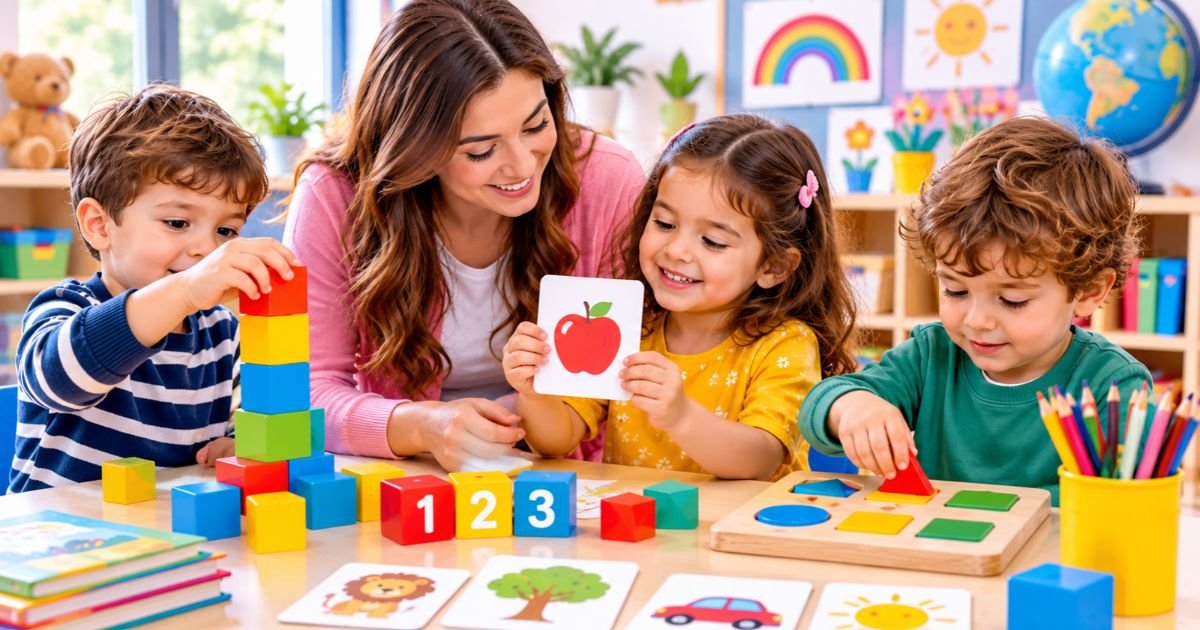
Children learn a great deal through everyday play. Building a tower, exploring leaves in the garden, singing nursery rhymes or creating a colourful picture can help them develop new skills while enjoying themselves. The best activities give young children opportunities to explore, ask questions and try things at their own pace.
For parents and early years practitioners, EYFS activities for preschoolers provide practical ways to support learning through play. These activities can encourage early communication, physical coordination, creativity, mathematical thinking and social development without making learning feel like a formal lesson.
In England, the Early Years Foundation Stage (EYFS) sets standards for children’s learning, development and care from birth to five. It includes seven interconnected areas of learning, with play and meaningful experiences helping children build the foundations for future learning.
Here are 12 engaging ideas that families and preschool practitioners can adapt to children’s interests, abilities and stages of development.
1. Colour Sorting and Matching
Colour games are an easy way to introduce early classification and observation. Arrange colourful blocks, cups or other child-safe objects on a play mat and invite children to group items that share the same colour.
Once they understand the basic idea, introduce a little variety. Ask them to find something yellow, match two objects that look alike or choose a favourite colour. You can also talk about the colours of familiar things, such as red apples, green leaves or blue skies.
Rather than turning the activity into a test, join in and describe what you see. Children can learn colour names through repetition and conversation.
EYFS learning areas: Mathematics, communication and language, and understanding the world.
2. Count Toys During Playtime
Counting does not need to involve worksheets or number cards. Everyday toys offer an opportunity to practise number words and connect them with real objects.
Place a few toy animals, building blocks or cars in front of the child. Count them together, moving each item as you say its number. Start with small groups and introduce more objects when the child is ready.
You can extend the game by building towers of different heights or asking which group has more toys. Tidying up also becomes a learning opportunity when children count objects as they return them to their boxes.
These small activities introduce early mathematical ideas in a familiar setting.
EYFS learning areas: Mathematics, physical development, and communication and language.
3. Storytelling with Picture Books
Stories help children explore language, imagination and emotions. Choose a colourful picture book and give children time to look closely at the illustrations rather than rushing through every page.
Ask open questions such as, “What can you see?” or “What do you think might happen next?” Encourage them to describe the characters, point out familiar objects and talk about how someone in the story might feel.
You can also invite children to retell part of the story using toys or their own words. There is no need for them to remember the exact sequence of events. The aim is to build confidence in listening, speaking and expressing ideas.
EYFS learning areas: Literacy, communication and language, and personal, social and emotional development.
4. Playdough Creations
Playdough gives children a chance to experiment with shapes, textures and movement. Encourage them to roll, press, squeeze and flatten the dough, creating pretend food, animals or imaginative designs.
As they work, introduce descriptive words such as smooth, soft, round, long and short. You could also compare two creations or ask children to make a shape they recognise.
Let each child decide what to create instead of expecting everyone to produce the same result. Use age-appropriate, non-toxic playdough and supervise young children, especially if they are still inclined to put materials in their mouths.
EYFS learning areas: Physical development, mathematics, and expressive arts and design.
5. Outdoor Nature Exploration
A visit to a garden, playground or local park can turn into an exciting learning experience. Encourage children to notice fallen leaves, different colours, clouds, birds and changes in the weather.
Give them time to explore safely and talk about what they observe. Ask whether one leaf looks different from another or how the weather feels today. You can also compare the size, shape and texture of suitable natural objects.
Nature activities introduce children to the world around them while encouraging movement and curiosity. Explain how to treat plants and wildlife gently, avoid unfamiliar plants and fungi, and wash hands after outdoor exploration.
EYFS learning areas: Understanding the world, communication and language, and physical development.
6. Build a Tower or Mini Town
Building blocks encourage children to experiment with height, balance, size and position. Invite them to construct a tall tower, a bridge for toy cars or a little home for their favourite animals.
As the structure grows, talk about what is happening. Is the tower taller than the previous one? Which block could go underneath? What happens if the blocks are arranged differently?
If a tower falls, give the child time to try again. Rebuilding offers a simple opportunity to explore problems and discover different solutions.
For a group activity, children can work together to build a shared town and decide where each building should go.
EYFS learning areas: Mathematics, physical development, and expressive arts and design.
7. Create a Pretend Shop
Role-play allows preschoolers to explore familiar situations through imagination. Set up a small pretend shop with toy food, a basket and clean, safe household packaging without sharp edges.
Take turns being the shopkeeper and customer. Children can ask for an apple, select items for a basket or describe what they would like to buy. Introduce simple counting by requesting two toy bananas or three pretend carrots.
The activity also creates opportunities to practise everyday language, take turns and listen to another person. Focus on the conversation and imaginative experience rather than formal money calculations.
EYFS learning areas: Communication and language, mathematics, and personal, social and emotional development.
8. Explore Floating and Sinking
A simple water activity can encourage children to observe, compare and ask questions. Fill a shallow container with a small amount of water and introduce a few large, waterproof objects suitable for young children.
Before placing an object in the water, ask the child what they think might happen. After observing the result, talk about whether the object floated or sank and whether different objects behaved in the same way.
Keep the activity supervised continuously and remain within arm’s reach. Young children can drown in very small amounts of water, so never leave them unattended and empty the container immediately afterwards.
EYFS learning areas: Understanding the world, mathematics, and communication and language.
9. Painting and Colour Mixing
Creative play gives children freedom to express ideas and explore colour. Provide washable, child-safe paints, large sheets of paper and suitable brushes or sponges.
Let children make marks, create patterns or paint whatever interests them. They might discover what happens when two colours mix or use a sponge to print repeating shapes across the paper.
Talk about the colours and patterns they notice, but avoid insisting that every picture must represent a particular object. The process of experimenting and making choices is an important part of the activity.
EYFS learning areas: Expressive arts and design, physical development, and communication and language.
10. Nursery Rhymes and Movement Games
Songs and action games combine listening, language, rhythm and physical movement. Choose familiar nursery rhymes and encourage children to clap, march, stretch or copy simple actions as they sing.
You can also introduce an animal movement game. Children might hop like rabbits, walk slowly like tortoises or flap their arms like birds. Invite them to suggest their own movements when they feel comfortable.
Adapt the activity to the available space and the needs of the children taking part. Some may enjoy energetic movement, while others may prefer watching before joining in.
EYFS learning areas: Physical development, communication and language, and expressive arts and design.
11. Picture Matching and Simple Puzzles
Matching games help children notice similarities and differences. Use picture cards featuring familiar animals, vehicles, fruits or household objects, and invite children to find matching pairs.
Start with a small number of pictures so the task feels manageable. When children become comfortable, introduce simple jigsaws or ask them to group pictures that belong together, such as animals or foods.
Give children time to work things out independently, offering a gentle hint when needed. The aim is to encourage exploration and problem-solving rather than speed.
EYFS learning areas: Mathematics, communication and language, and understanding the world.
12. Make a Simple Indoor Obstacle Course
Movement activities can help children practise balance, coordination and following instructions. Arrange floor markers, soft cushions and suitable play equipment to create a short route around a clear, safe space.
Invite children to walk around a cushion, step between markers or crawl through a play tunnel designed for their age. Demonstrate the route first, then allow them to try at their own pace.
You can introduce simple position words such as around, between, over and beside. Keep the course free from tripping hazards, avoid unstable furniture and adapt the activity for each child’s abilities.
EYFS learning areas: Physical development, mathematics, and communication and language.You can read the current guidance on the official EYFS page on GOV.UK.
How to Choose EYFS Activities for Different Learning Areas
Not every activity needs to teach just one skill. Many preschool experiences support several areas of development at the same time.
| EYFS learning area | Activities to try |
|---|---|
| Communication and language | Storytelling, picture discussions and sound games |
| Personal, social and emotional development | Pretend play, taking turns and cooperative building |
| Physical development | Playdough, painting, outdoor movement and obstacle courses |
| Literacy | Picture books, nursery rhymes and listening games |
| Mathematics | Counting objects, sorting colours, matching shapes and building |
| Understanding the world | Nature exploration, floating experiments and observing everyday objects |
| Expressive arts and design | Painting, music, construction and imaginative play |
When choosing EYFS preschool activities, consider what the children already enjoy and which skills they are beginning to explore. An activity should create an opportunity to learn, not become a checklist of things every child must complete.
Adapt Activities to Children’s Needs
Children learn in different ways and at different rates. Some may enjoy clear instructions and a predictable routine, while others prefer open-ended activities and independent exploration.
You can make an activity more accessible by reducing the number of objects, demonstrating each step, providing extra time or using visual prompts. Larger pieces may be easier for some children to handle, while a quieter space can help children who find busy environments overwhelming.
Parents, carers and practitioners should share relevant information about children’s interests and support needs so activities can be adapted appropriately.
How to Make Preschool Learning More Enjoyable
Follow children’s interests
A child who loves animals might enjoy counting toy animals more than using number cards. Another child might prefer music, drawing or outdoor exploration. Starting with familiar interests can make new experiences more engaging.
Use everyday materials
Books, blocks, paper, safe household objects and toys can provide plenty of learning opportunities. An activity does not need to be expensive or elaborate to encourage development.
Leave room for exploration
Children often learn by repeating an activity, trying different approaches and making discoveries. Allow them to experiment rather than directing every step or expecting a particular outcome.
Encourage conversation
Describe what children are doing and introduce new words naturally. Instead of repeatedly asking for the correct answer, ask what they notice, what they would like to try or how they made something.
Balance different kinds of play
Combine creative activities with stories, movement, outdoor experiences . A varied selection helps children explore different interests and skills throughout the day.
Frequently Asked Questions
What are the best EYFS activities for preschool?
Counting games, colour sorting, storytelling, playdough, nature exploration, construction and imaginative play are useful options. Choose based on children’s interests, abilities and the learning opportunities you want to encourage.
Can EYFS activities be done at home?
Yes. Families can explore similar learning experiences through reading, singing, counting everyday objects, drawing and outdoor play. The EYFS framework itself applies to early-years providers in England.
How long should a preschool activity last?
There is no single duration that works for every child or activity. Keep activities flexible, follow children’s engagement and allow them to take breaks or return later.
Do preschool activities need special equipment?
No. Many activities use everyday materials such as books, blocks, paper, washable paints and suitable household objects. Always check materials for age suitability and supervise young children.
Are EYFS activities only for children aged three to four?
No. The EYFS framework in England covers children from birth to five. Activities should be adapted to a child’s age, development, interests and individual needs.
Final Thoughts
Early learning does not have to involve complicated resources or formal lessons. Children can explore numbers through building blocks, develop language through storytelling and discover the natural world through simple outdoor experiences.
When planning activities for preschoolers, focus on opportunities to explore, communicate, create and move. A balanced selection of EYFS preschool activities can make everyday learning enjoyable while supporting children’s growing confidence and curiosity.
For more ideas, choose activities that connect with children’s interests and adapt them as their skills develop. Small, playful experiences can create valuable opportunities for learning at home or in an early-years setting.

Carter John is a writer at KnowsDaily, covering a wide range of topics, including lifestyle, technology, travel, finance, education, and everyday life. He focuses on creating clear, informative, and engaging content that helps readers find useful answers, explore new ideas, and make informed decisions. Through his work at KnowsDaily, Carter aims to make everyday information accessible, practical, and easy to understand.
1 thought on “EYFS Activities for Preschoolers: 12 Fun Ideas for Early Years Learning”